

Every summer, the world’s most extraordinary yachts trace a broad arc across the Mediterranean. It is not a fixed itinerary, and it is emphatically not dictated by a regatta calendar. It is shaped by something more human: the pull of beautiful places, the concentration of interesting people, the rhythm of long warm days and the quality of what awaits ashore. Understanding the Mediterranean superyacht circuit is, for those who participate in it or aspire to, one of the more useful forms of insider knowledge available. Here is how it unfolds in 2026, and why this particular summer has a character all its own.
2026: the circuit moves west
Before tracing the circuit itself, one development reshapes the picture for 2026 in ways that matter to anyone planning time on the water. The conflict between Iran and the United States in early 2026, and the subsequent security concerns across the eastern Mediterranean, have redirected a significant portion of the global superyacht fleet toward the western basin. Greece, Turkey and the Adriatic, which in previous summers attracted a meaningful share of the circuit’s participants, are being largely set aside this season in favour of France, Italy and Spain. Industry sources tracking port asset performance describe 2026 as an exceptional year for the western Mediterranean. France, Italy and Spain will see a very good season, driven by owners who have redirected their plans with a decisiveness that the industry has not seen since the pandemic.
For buyers and owners whose focus is the French Riviera, Monaco, Ibiza and the Italian south, this concentration brings both heightened energy and, in practical terms, the need to secure berths, restaurants and logistics further in advance than in previous years.
June: the season opens on the French Riviera
The Mediterranean superyacht circuit has an undisputed starting point: Monaco in the first week of June. The Formula 1 Grand Prix de Monaco, taking place on 4 to 7 June 2026, transforms Port Hercule into one of the most exclusive gathering points in the world. Dozens of significant yachts line the harbour, their decks offering vantage points that simply cannot be replicated ashore. The Grand Prix weekend is as much a social event as a sporting one: the concentration of the world’s most interesting people in two square kilometres, across five days, creates a density of connection and conversation that no other event on the calendar matches.
After the race, however, the fleet does not stay in Monaco. Port Hercule is exceptional for an event but is, by the standards of a summer at sea, a relatively constrained environment. The natural post-Grand Prix move is to the broader French Riviera, and specifically to the anchorages and ports between Antibes and Saint-Tropez. Antibes and Cannes function as the true operational bases of the Mediterranean superyacht season. Their infrastructure, their capacity for significant vessels, and their position at the centre of the Riviera make them the practical headquarters of the circuit’s first act. Cap d’Antibes, with its protected coves and proximity to the town, offers the combination of privacy and access that defines the best anchorages on the circuit.
Saint-Tropez, further west, occupies a unique position: simultaneously one of the most visited ports on the Riviera and, in the right conditions, one of the most pleasurable. The port itself is intimate enough that anchoring in the bay and arriving by tender preserves a quality of experience that being in the harbour directly does not. The beaches of Pampelonne, the market in the old town, the particular quality of the evening light: Saint-Tropez in June, before the full intensity of July descends, offers the French Riviera at its most genuinely itself.
Late June into July: the fork in the road
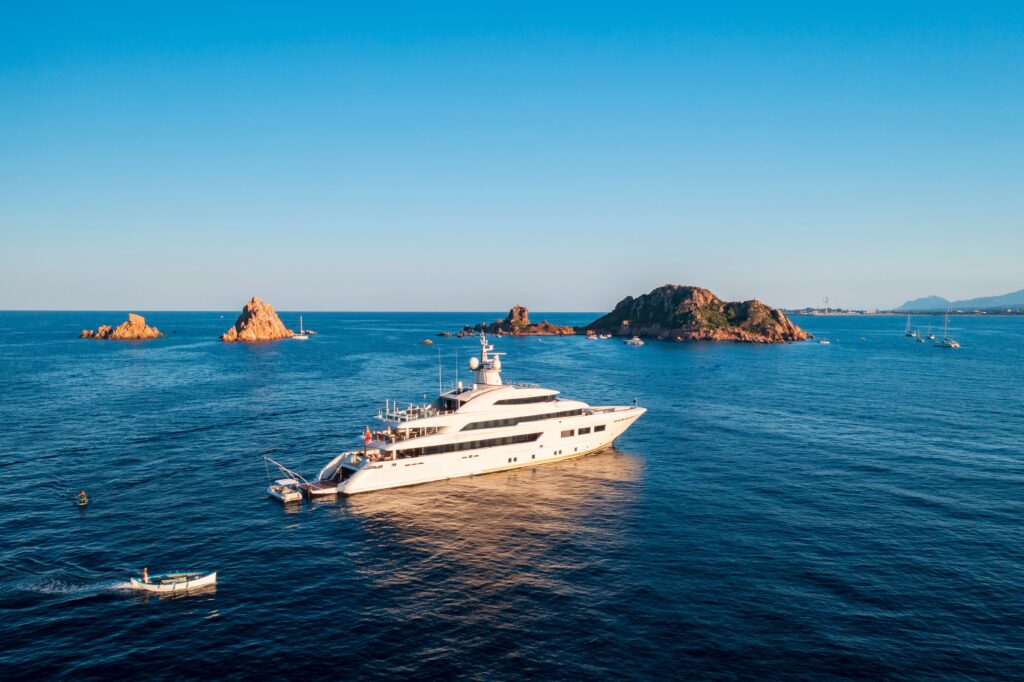
By late June, the circuit reaches its most defining moment of navigation. Owners face a choice that shapes the entire summer: east toward Corsica, Sardinia and the Italian south, or west toward the Balearics and Ibiza. The two routes are not mutually exclusive across a full season, but most yachts commit to one or the other as their primary direction, looping back only if time and logistics allow.
Those heading east typically make their first significant stop in Corsica. Bonifacio, in the island’s south, is one of the most dramatically situated ports in the Mediterranean: limestone cliffs dropping sheer to turquoise water, a medieval citadel perched above the strait that separates Corsica from Sardinia. The crossing through the Strait of Bonifacio, while occasionally demanding, leads directly to Sardinia’s La Maddalena Archipelago, a national park of scattered granite islands where the water achieves a Caribbean clarity that surprises even experienced cruisers. The anchorages here are among the most extraordinary available anywhere in the western Mediterranean.
Those heading west from Saint-Tropez make for Mallorca and the Balearics. Palma, with its world-class refit and provisioning infrastructure, functions as the western circuit’s operational base in much the way that Antibes does on the Riviera. From Palma, the natural progression is to Ibiza: the northern bays of the island for privacy and extraordinary anchorages by day, Ibiza Town or the beach clubs of the south for the evenings. Formentera, twenty minutes by tender to the south of Ibiza, offers what the main island increasingly cannot: genuine quiet, white sand sandbars, and a quality of solitude that the world’s finest yachts seek and that is becoming genuinely scarce.
July and August: Sardinia, the Amalfi Coast and Sicily
For those on the eastern circuit, July brings Porto Cervo and the Costa Smeralda. Founded by the Aga Khan in the 1960s, Porto Cervo is the social peak of the Sardinian summer. The Piazzetta in the evenings draws an audience that represents the international concentration of wealth, style and maritime culture at its most distilled. The beaches of the Costa Smeralda, white sand over water of an extraordinary transparency, are among the finest in Europe. The provisioning, the restaurants, and the infrastructure for significant yachts are all of the highest standard. Porto Cervo in July and August is, for many owners, the emotional centre of the Mediterranean summer.
From Sardinia, the circuit extends south to Italy’s most spectacular cruising grounds. The Gulf of Naples and the Amalfi Coast are, by any measure, among the most beautiful stretches of water in the world. Capri rewards early arrival: the Blue Grotto approached by tender at first light, before the day visitors arrive, is an experience available only from the water. The cliffs of Positano descend directly to the sea. Ravello sits above the coast with views that have made it one of the most painted places in Europe. Ischia, often overlooked in favour of its more famous neighbours, offers thermal spas and botanical gardens that make it an ideal destination for rest between more social stops.
From the Amalfi Coast, the most adventurous move is south and west to the Aeolian Islands, the UNESCO-listed volcanic archipelago off northeastern Sicily. Panarea, the smallest and most fashionable of the seven islands, is a summer gathering point for Italian high society: the anchorage fills with significant yachts each July and August, and the village’s small restaurants operate with an intensity entirely disproportionate to the island’s size. Stromboli offers something no other anchorage on the circuit can: the experience of watching an active volcano erupt against the night sky, sending glowing rocks down its flanks every twenty minutes. It is, by the consensus of those who have done it, one of the most extraordinary things available to anyone on the water.
August: the great offshore passages
August is when the circuit’s most ambitious passages take place. One of the most elegant connects Sicily, Sardinia and Monaco in a single voyage: the Palermo to Monte-Carlo race, organised jointly by the Circolo della Vela Sicilia, the Yacht Club de Monaco, and the Yacht Club Costa Smeralda, departing from Mondello’s Gulf in Sicily and finishing in Monaco via a gate off Porto Cervo. Over 450 nautical miles, the race traces in competition the same arc that the circuit follows more leisurely across the season. For those not racing, it is a reminder that the western Mediterranean is, at its best, a connected geography rather than a series of isolated destinations.
By late August, the circuit begins its final turn. The fleet moves gradually north and west, back toward the Riviera and toward Antibes and Cannes, where the Cannes Yachting Festival in September marks the social and commercial end of the Mediterranean summer before the fleet prepares its transatlantic passage to the Caribbean for the winter.
What the circuit is really about
The most important thing to understand about the Mediterranean superyacht summer circuit is that it is not, at its core, about movement. The owners who extract the most from it are not those who cover the most distance but those who choose their stops with the most intention, stay long enough to genuinely inhabit a place, and build their summer around the quality of what each destination offers rather than the prestige of being seen to have visited it.
As research consistently shows, the defining luxury of time on the water is autonomy: the ability to stay an extra day in a bay you have fallen in love with, to change course because the weather is perfect for a particular crossing, to arrive somewhere before the crowds and leave when the mood suggests. That quality of freedom, set against the backdrop of the Mediterranean’s most extraordinary coastlines, is what makes the circuit irreplaceable for those who have experienced it.
For those who complement their time on the water with property ashore, the circuit and the Orion network’s markets are naturally aligned. A base in Monaco provides the perfect starting point for the season and a home for the Grand Prix. A property in Ibiza extends the summer westward with all the island offers beyond the anchorage. The two together, connected by the arc of the circuit that runs between them, represent a way of spending the summer that requires very little further explanation.
To explore property opportunities in the world’s most prestigious destinations, contact our team and we will delighted to assist you.