

Most people encounter Ibiza at its loudest. They arrive in July, leave in September, and carry with them an impression of an island defined by beach clubs, superyachts, and crowds. That impression is accurate, as far as it goes. But living in Ibiza beyond the summer tells a completely different story, and in 2026, it is a story that a growing number of internationally mobile families, remote professionals, and long-term property buyers are choosing to write for themselves.
The island does not close in October. It exhales.
What actually changes when the season ends
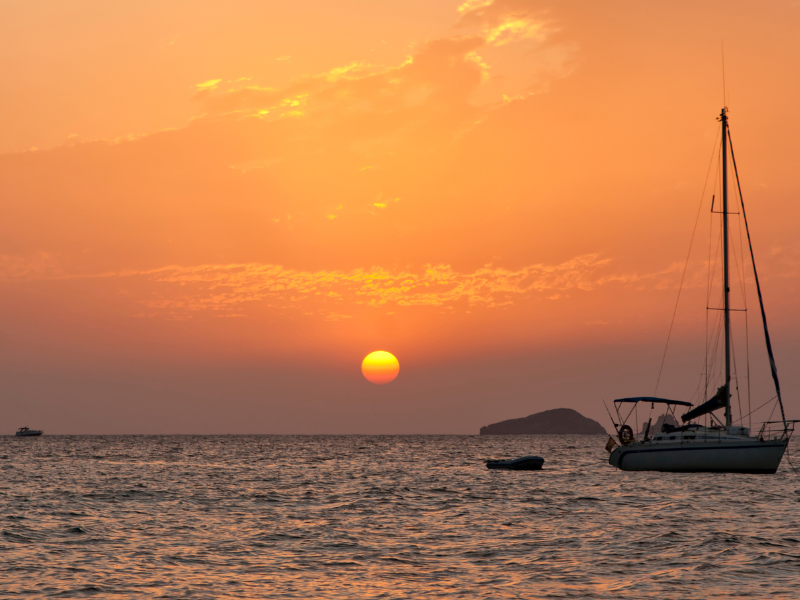
From late October, the transformation is immediate and striking. The roads empty. The restaurants that spent summer turning tables in under an hour suddenly have space, time, and a willingness to cook properly. The beaches, some of the most beautiful in the Mediterranean, become places for morning swims and evening walks rather than choreographed performances. The light softens. The pace of life shifts in a way that is difficult to describe to anyone who has only ever seen the island in high season.
The major clubs close. Almost all of them shut from late October through to the last weekend of April, when the official season reopens. The exceptions are few: DC-10 hosts the legendary Circoloco New Year’s Day event, and Pacha maintains a reduced programme of occasional weekends through winter. For residents, this is not a loss. It is precisely the point. The island that emerges from under the summer is quieter, more communal, and more genuinely itself.
Temperatures through autumn and winter are mild by any northern European standard. November averages around 17 degrees Celsius. January and February rarely drop below 10. By March, the island is warming again, the almond trees are in bloom, and the first of the early-season arrivals begin to appear. For anyone considering living in Ibiza beyond the summer, the climate alone makes the case.
The food scene that most visitors never see
Summer dining in Ibiza is spectacular by reputation, but it is also transactional. Tables turn fast, menus are designed for volume, and the connection between kitchen and table is often managed across language barriers and time pressure.
Autumn and winter change this entirely. The restaurants that remain open are the ones run by people who chose to stay, and they cook accordingly. Menus shift with the season, leaning into the island’s traditional Ibizan cuisine: bullit de peix, the slow-cooked fish stew that is the island’s defining dish; frita de pulpo, octopus fried with local red potatoes; and sofrit pagès, a hearty meat and potato stew that speaks of the island’s rural interior rather than its coastline.
Throughout autumn and winter, a series of gastronomic festivals brings the local community together in a way that summer, with its international influx, cannot replicate. The Squid Festival in Sant Carles celebrates the opening of the squid fishing season with local chefs competing on traditional and contemporary preparations. The Salt Festival in October takes place at the Parc Natural de Ses Salines, one of Ibiza’s most extraordinary natural landscapes, and centres on the traditional dish of ossos amb col, pork bones with cabbage, served on the opening day. These are not events designed for tourists. They are the island feeding itself, and visitors who happen to be present are welcomed into something genuinely local.
Furthermore, a wave of ambitious new restaurants has opened in recent years specifically targeting the year-round resident rather than the seasonal visitor. The Amorous Project in Ibiza Town, opened in 2025, brings a culture-spanning menu inspired by the culinary melting pot of 1920s New York. Can Curuné, set in the island’s countryside, offers a seasonal menu of slow-cooked meats and local produce that changes with what is available. These are the restaurants where reservations feel like privileges, and where the experience of eating in Ibiza reveals itself most honestly.
A growing community of year-round residents
The shift in how Ibiza is perceived as a place to live rather than a place to visit has accelerated significantly since 2020. According to recent market data, a notable increase in « first home » buyers, meaning buyers purchasing Ibiza as their primary residence rather than a holiday property, was recorded in 2024 and continued through 2025. International families from across northern Europe and the Middle East are choosing to settle permanently, and the island’s infrastructure has responded accordingly.
Education is a key driver. Morna International College, located in Santa Gertrudis, is the island’s most established international institution, offering the British curriculum from ages 3 to 18, with fees ranging from approximately €12,650 to €21,550 per year depending on year group. French curriculum families are also well served. For parents who have relocated from London, Paris, or Geneva, continuity of international education is often the deciding factor, and Ibiza now delivers it reliably.
Healthcare has similarly matured. The island has both public hospitals and a growing network of private clinics that cater to an international clientele. Many long-term residents combine the Spanish public health system with private insurance for specialist access, an arrangement that costs considerably less than comparable private cover in London or Zurich.
Connectivity, moreover, has improved considerably in recent years. In winter 2025, airlines introduced earlier seasonal routes, with March flights beginning three weeks ahead of 2024 schedules. Year-round connections to London, Paris, Amsterdam, Zurich and Madrid are well established, and many international residents supplement these with private aviation, reducing the journey between Ibiza and London to approximately two hours. For professionals managing international businesses, this accessibility has removed what was previously the main objection to island living as a permanent arrangement.
Living in Ibiza beyond the summer as a property investment
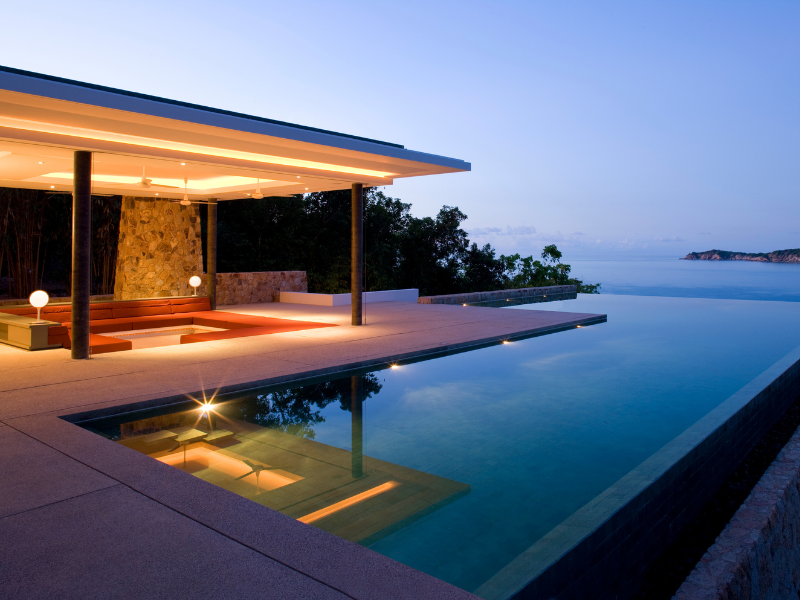
The shift towards year-round occupation has had a measurable effect on the property market. As of early 2026, average property prices in Ibiza sit at approximately €7,000 per square metre, with prime waterfront districts such as Marina Botafoc exceeding €7,500 per square metre. Luxury villas in standout locations command well above €10,000 per square metre. The typical residential transaction value now sits at approximately €1.1 million, roughly five times the Spanish national average.
Importantly, the market in 2025 shifted towards a more balanced dynamic after several years of extreme seller conditions. Transaction volumes remained solid, but buyers became more selective and negotiations returned to the process. Well-positioned, turnkey properties in prime locations continued to perform strongly, while properties requiring significant renovation faced longer selling periods. For buyers, this represents a more considered environment than the urgency-driven market of 2021 and 2022.
Price growth in the luxury segment is forecast at between 7 and 12 percent in 2026, driven by scarcity, lifestyle demand, and long-term capital preservation rather than speculation. Supply constraints are structural, not cyclical. Land availability on the island is genuinely limited, and the Balearic Islands’ strict development regulations mean that significant new supply is unlikely to materialise at scale. For buyers focused on long-term value, that combination of scarcity and sustained demand provides a level of structural confidence that few comparable markets can offer.
The rental market further strengthens the investment case. Rents on the island rose by between 8 and 15 percent during 2025, driven partly by the housing shortage and partly by the growing number of long-term residents competing for quality stock. For owners who manage their properties professionally during the summer season and occupy them personally through autumn and winter, the yield potential is substantial.
What Absolutely Ibiza knows that most buyers don't
Delphine Mao, founder of Absolutely Ibiza and an Orion member agency, has lived on the island full-time for over a decade. She arrived from the French Riviera and Monaco, spent twenty-five years working at the highest levels of the luxury sector, and chose Ibiza as the place to build something of her own. Her perspective on living in Ibiza beyond the summer is not that of an observer. It is that of someone who has watched the island change through every season and understands precisely what it offers when the crowds have gone.
Her agency, certified by the Balearic Association of Real Estate Agents, accompanies buyers not just through the transaction but through the full experience of island living: property management, relocation logistics, lifestyle support, and the kind of local knowledge that only comes from genuine, long-term presence. In a market where relationships and local insight determine access to the best properties, that kind of embedded expertise is not incidental. It is the difference between a house on an island and a home within a community.
For buyers considering living in Ibiza beyond the summer, the conversation begins with understanding what the island actually is, not in August, but in November, in February, and in the long, warm days of a Mediterranean spring when the beaches are empty and the restaurants are cooking for the people who decided to stay.
That is the Ibiza that those who know it best tend to keep quietly to themselves. And for good reason.
To explore property opportunities in Ibiza with visit Absolutely Ibiza’s website or contact us directly.